Blog

I had always wanted to do a longer research visit during my bachelor’s and master’s studies. Somehow, there was always something in the way. Later came a doctoral degree, my own research team, and eventually a new phase of academic life as an Assistant Professor, trying to establish my own research direction.
At that stage, an international research visit was no longer optional in my mind. It felt like something I needed to do to grow as a researcher and to see what I could achieve in a completely new environment.
At the same time, things do not get simpler with age. Quite the opposite. There are students, research projects, teaching, responsibilities, and family life, all competing for the same limited time and attention. The idea of leaving for several months is no longer just an academic decision, but a life decision.
Why would anyone risk a good and balanced life to move to the other side of the world at a time when stability often feels like the most valuable thing to hold on to?
When I started looking into longer research visits, the United States was not my first choice. In fact, it was far from it. Like many Europeans, I carried a set of assumptions and stereotypes that made me unsure whether I would feel at home there at all.
Growing up in a small village in northern Finland, the United States always felt distant. Almost like a different world.
And perhaps that is exactly why it became interesting.
I was lucky to get encouragement from colleagues who had experienced Santa Barbara before. It felt like Santa Barbara had something I couldn't quite understand yet. Something I needed to experience for myself.
Before leaving Finland, I was occasionally asked whether this was the right time to spend several months in the United States. My answer was simple: if the goal is to understand another country, culture, and society, there is rarely a better moment. Waiting for “better times” can easily become a reason to never go at all.
Growth rarely happens when everything feels comfortable. I had already waited long enough.
Spring 2025 brought an unexpected challenge.
I had planned the visit carefully. Then, changes in regulations suddenly cast uncertainty over the visa process. Several months passed without knowing whether the trip would happen at all.
Meanwhile, life moved on. We had to give up my daughter's preschool place at the nearest kindergarten, my wife Jenny postponed looking for a new job in Finland, and our apartment was on sale. If the visit did not happen, putting everything back together would not be easy.
Summer arrived, yet we were still unable to schedule visa interviews. The process seemed stuck.
At that point, without the Fulbright Finland Foundation, I would probably have given up. The support from the Foundation was absolutely essential.
About a week before our departure, the visas were finally approved.
The first challenge had been solved. The adventure could begin.
When I arrived at the University of California, Santa Barbara, as a Fulbright Finland Foundation and Nokia Foundation Fellowship for a Junior Scholar awardee, my primary goal was clear: to advance my research in radio engineering, build personal relationships, and learn how leading research groups operate.
While the scientific goals were ambitious, I adopted a simple approach. The best way to learn is not to bring your own problems for others to solve, but to contribute your own expertise to challenges that already exist. This turned out to be a good strategy. Eventually, I found myself working on exactly the kinds of topics I had hoped for, together with extremely talented people. Long days and evenings in the laboratory with circuits I had always wanted to test.
UCSB has a long tradition of scientific excellence. I encountered it in an unexpected way on my very first day. The office assigned to me had previously belonged to Professor Herbert Kroemer, recipient of the 2000 Nobel Prize in Physics. Professor Kroemer had passed away a couple of years before my arrival. His drawings were still on the whiteboard.
Somehow, the history and dignity of the place felt tangible. I felt deeply honored.
Looking back, however, the experience became much more than a research visit. For seven months, California became home not only for me, but also for my wife and our two young daughters.
Taking four- and six-year-old daughters to the other side of the world is no small undertaking. It requires careful planning, flexibility, and a fair amount of optimism. Fortunately, everything went remarkably well, thanks largely to my wife.
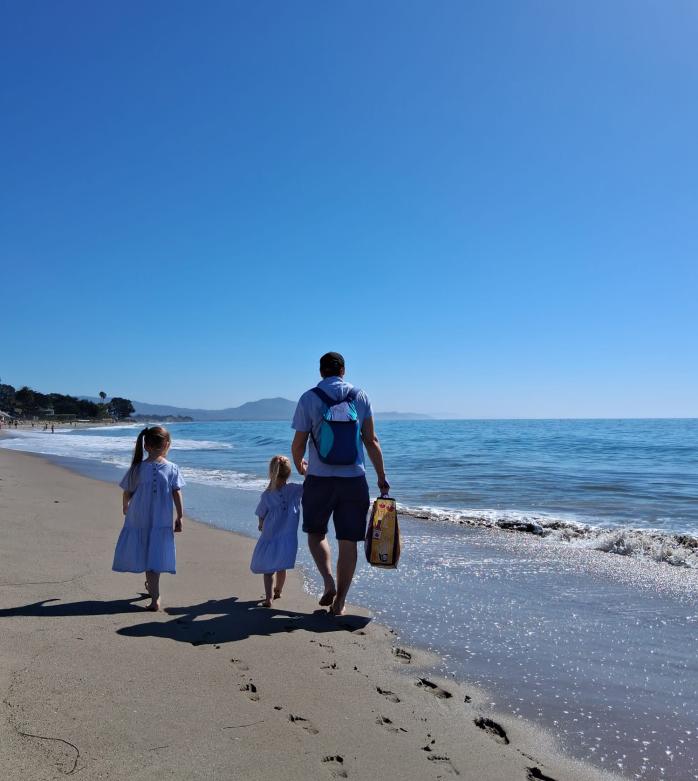
At first sight, Santa Barbara looked like a paradise from our daughters' perspective as well. Beautiful nature, sunshine almost every day, long beaches, and endless opportunities to explore.
People were polite and said hello in the streets. They were genuinely interested in who we were and where we came from. Many stopped to compliment our daughters. Neighbors offered help and made us feel welcome.
As a Finn, this initially felt a little unusual, but also surprisingly nice.
While the U.S. academic culture may sometimes appear professor-centric, at least the team I worked with was very student-driven. Extremely professional, far from micromanagement. Motivated and talented individuals forming a highly functional team. Of course, in an international environment, there are probably as many ways of doing and leading research as there are people in those universities.
Still, two things stood out: courage and optimism.
In research, discovering something new requires courage, and courage always comes with the possibility of failure. In this environment, failure was not something to avoid at all costs. It was accepted as part of the learning process and often became part of the story behind eventual success. This was something I realized I still needed to learn myself.
My main goal in science has always been to promote interdisciplinary collaboration. I did not join a team that was doing exactly the same things as I was. Instead, I joined a team where I felt I could contribute, teach, and learn at the same time.
After more than ten years of research within the same group in Finland, sharing knowledge and gaining new perspectives in a different environment generated an extraordinary number of new ideas. Suddenly, everything you have worked on for years seems to make sense.
In the end, this is what the academic part of the research visit is really about. You learn what you know, share it with others, and at the same time gain new ideas from places you did not see before.
But there is still more.
Santa Barbara is one of the most child-friendly places I have ever visited. You truly feel welcome as a family. Wherever you go, children have been taken into account. We received dinner invitations and invitations to playdates in local parks. In restaurants, children are always welcome. This seemed to be part of the culture.
After a few months of consideration, we enrolled our daughters in a local school and kindergarten. Within a surprisingly short time, they learned to communicate in English at a decent level. More importantly, they learned the courage to step into a completely new environment. I am sure the experience will stay with them for the rest of their lives.
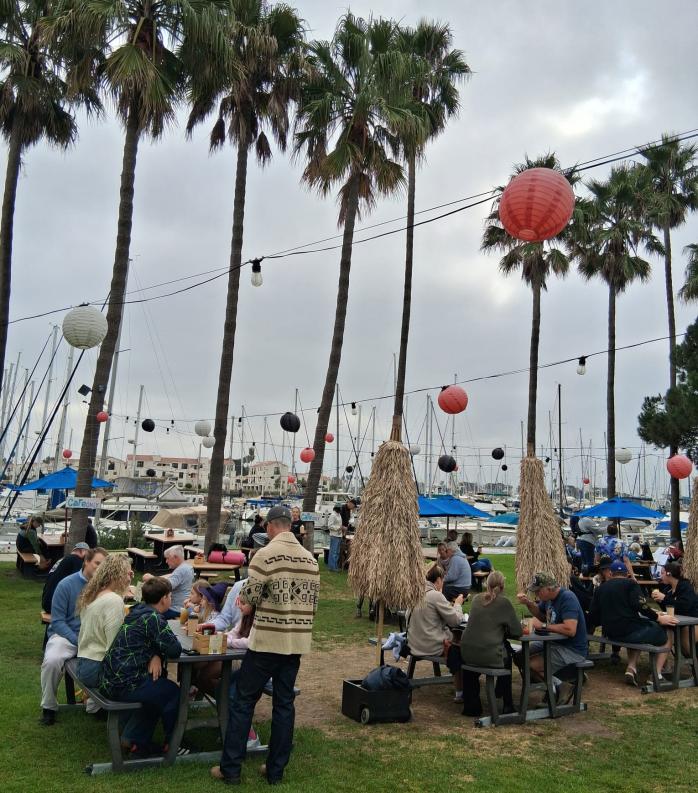
One of the greatest strengths of the Fulbright Finland programs is the support network that helps you settle into a new environment and build local connections from day one. During our first weeks in Santa Barbara, we received several introductions from Fulbright Finland alumni who welcomed us and offered their help.
For example, we had the privilege of meeting Fulbright Distinguished Award in Teaching recipients Robyn Young (2018–19), and Annie Ransom (2019-20), together with their families. Knowing another family who had gone through a similar experience with children made us feel immediately welcome and at home.
One day, we met an older lady at a playground near the campus. She was there with her friend's daughter. Visiting the playground every week, on the same day and at the same time, had become part of their routine.
What started as a casual conversation gradually became one of the most memorable experiences of our entire visit. Our whole family became close friends with them. Through someone who had spent more than seventy years living in the United States, we gained a perspective on American society that no book, newspaper, or university could have provided.
It was remarkable to realize that a friendship with someone more than forty years older than yourself could feel so natural and become such an important part of our lives.
Another memorable moment came at a playground close to our home. I was there with my daughters when we started chatting with a man who was visiting the playground with his adult daughter and her children.
As the conversation unfolded, we discovered that he had been a Fulbright Finland grantee more than thirty years earlier. Even more remarkably, his daughter had been a young child during that Fulbright experience and had come along with the family, just like my daughters had come with us.
Standing there in a playground in Santa Barbara, watching the next generation play together, it was impossible not to see the continuity of the Fulbright experience across generations.
At that moment, I felt especially proud to be a Fulbright Finland grantee.
The Fulbright Finland experience made me realize a simple but important lesson. Research is ultimately done by people. Individuals whose ideas are shaped by their experiences, personalities, networks, and histories.
Even in engineering science, which may appear highly technical at first sight, research is never only about facts or knowledge. The ability to think, understand, and innovate comes from everything we experience along the way.
In the era of AI, when knowledge is always available within seconds, these lived experiences feel even more important. They are not just background to research, and they cannot be learned by chatting with your favorite AI tool. They are part of what makes research possible in the first place. At the same time, they are part of a longer continuum, where ideas, mentorship, and traditions are passed across generations.
I am writing this while on a plane to Boston to present research results from UCSB at a leading conference in microwave engineering. There is, of course, an academic outcome to this journey as well.
Personal relationships open doors, but they also create opportunities to give something back in return. In the same way, academic life is deeply intergenerational: we build on the work of those before us, and we hopefully pass something meaningful forward to those who come after us. At the same time, this experience with my family has been something much broader than academic work alone. It will also shape the next generation.
No two research visits are ever the same. There is always something to explore, experience, and learn. Yet what stays with you most is often the feeling of being at home in a place far away from home.
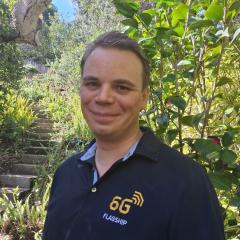
Nuutti Tervo is Assistant Professor (tenure track) at the University of Oulu and the 6G Flagship. He spent 7 months at the University of California, Santa Barbara as the Fulbright Finland Foundation and Nokia Foundation Fellowship for a Junior Scholar awardee and a Kaute Researchers Abroad grantee. He traveled together with his wife and small daughters.