Fulbright Finland News Magazine
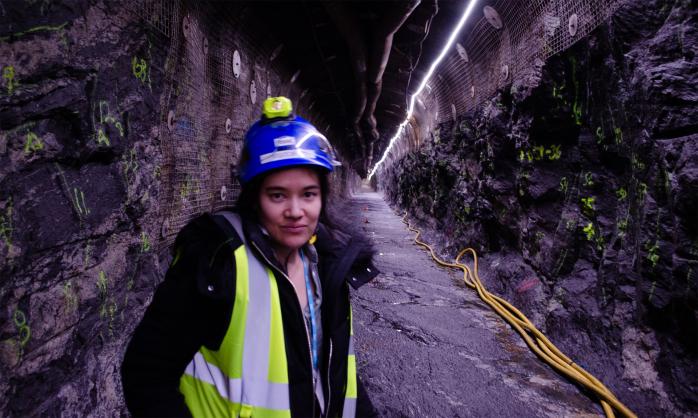
When I was awarded the 2025-26 Fulbright Finland Doctoral Award to collaborate with the Spectral Imaging Laboratory at the University of Jyväskylä, I knew I also had to visit Onkalo, the world’s first long-term repository for spent nuclear fuel in Eurajoki, Finland.
In February, I joined the last media tour at Onkalo before the first stores of spent nuclear fuel will be encapsulated and buried there. I am not a nuclear scientist, but an ecologist researching the environmental impacts of nuclear power. I develop hyperspectral remote sensing methods to detect changes in vegetation after they are exposed to environmental contaminants associated with nuclear fuel processing. Operationalizing my research would transform how we monitor landscapes for contamination, which would improve risk assessment, hazard mitigation in emergencies, and help evaluate remediation efforts.
My thoughts on nuclear power are complicated. Though the U.S. has an undeniable obligation to decarbonize our economy, we have failed to develop a long-term national strategy to secure our nuclear waste. When the proposed repository at Yucca Mountain stalled in 2011, it was an important victory for democracy and indigenous sovereignty. But ending the Yucca Mountain repository also ended all plans to permanently store nuclear waste now distributed across the country, endangering communities and ecosystems.
Onkalo shows there can be a better path forward. One of the mandates of the 1994 Finnish Nuclear Energy Act is that operators using nuclear power in Finland must take responsibility for the waste they produce.
This meant banning international exports and imports of nuclear waste and massively investing in research for safe, permanent storage solutions. This year, Onkalo will transition to the encapsulation and burial phase where radioactive waste will be sealed into bedrock. This phase is a major milestone for Finland’s leadership in nuclear science and an unprecedented scientific achievement. Through decades of research and planning, Finland has set the global standard for geologic repositories and modelled responsible, accountable governing in the nuclear age.
Despite this well-earned acclaim, public perception in the U.S. seems to conflate this new phase of Onkalo’s operations with the final hurdle before broadly implementing geologic repositories as a virtual panacea for the nuclear industry’s waste problems. In the U.S., complementary markets are already preparing to leverage the science at Onkalo into a multinational trade that commodifies nuclear waste storage capacity while pooling risk across operators. Such markets are antithetical to the national values that led Finland to build Onkalo.
Onkalo is not a product. It is a 100,000-year-long experiment. Onkalo cannot be both an unprecedented scientific frontier and ordinary infrastructure. This is obvious to those within the nuclear industry, but not necessarily to the public. Framing Onkalo as an ongoing experiment instead of collapsing it into a pedestrian technological application is the difference between meaningful engagement and pacifying the public into premature complacency. Finland cannot control bad outcomes in other countries, but Finland can show rhetorical leadership by messaging the unprecedented, experimental nature of Onkalo, which actively counters the corporate interests rushing to commodify systems we are still learning to understand.
Kate Thompson
PhD Candidate
University of Wisconsin, Madison
2025-26 Fulbright Finland Doctoral Award
University of Jyväskylä
Read the whole Fulbright Finland News magazine 1/2026!