Fulbright Finland News Magazine
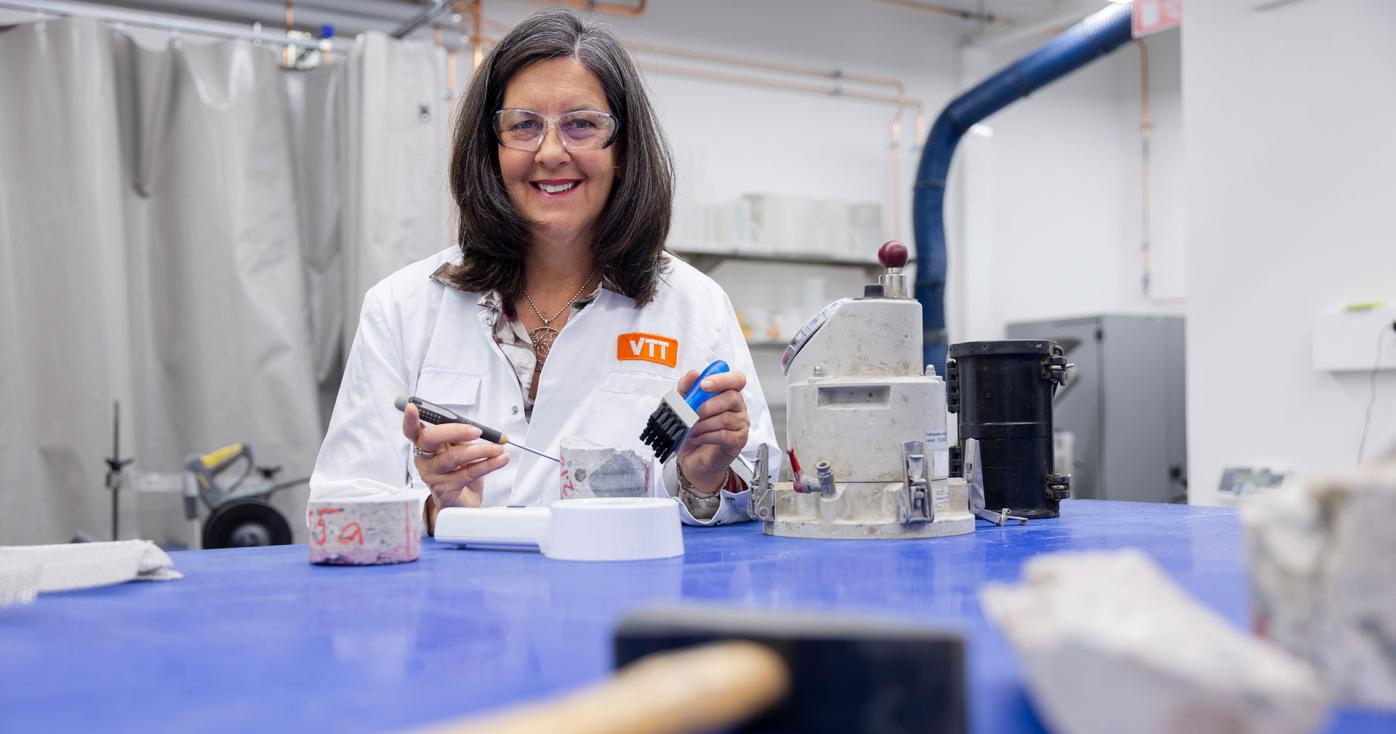
How do you make something safe not just for decades, but for thousands of years? Fulbright alumna Dr. Erika Holt, a civil engineer and technical expert at VTT Technical Research Centre of Finland, has built her career around such questions.
Originally from Seattle, Erika first came to Finland in the 1990s through her graduate studies at the University of Washington, researching how concrete and other building materials could be made more durable in harsh environments - with a Fulbright grant later enabling her to cotinue her doctoral research at VTT.
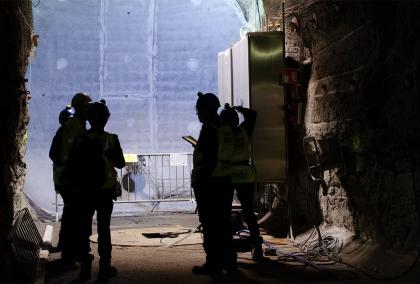
Today, Erika’s work is closely connected to one of Finland’s most internationally significant areas of expertise: the safe geological disposal of spent nuclear fuel.
“Many countries have nuclear power. That decision was made fifty or more years ago, but the outcome is also that they have legacy waste,” she says. “Finland is the first in the world that will have a solution for how to put used, or spent, nuclear fuel safely underground.”
Erika explains that her path to Finland began well before her Fulbright. Her family roots are Finnish: her grandmother was from Joutsa, around three hours north of Helsinki, and she grew up in the Seattle area surrounded by plenty of reminders of Finnish culture and connections.
“My parents had travelled to Finland, and my grandparents still had a summer cabin and sauna and close relations here. I grew up listening to Sibelius and having Marimekko napkins and Iittala glassware at my grandparents’ house in Seattle.”
One of her professors at the University of Washington had professional connections with VTT and, through a university scholarship supporting exchange between the University’s civil engineering and architecture departments and the Nordic countries, Erika came to Finland in 1996 for what was initially intended to be one year of master’s research.
That turned into a second year, with Erika beginning work toward her PhD, during which time she applied for a Fulbright grant to continue her doctoral research at VTT. And, following her Fulbright year, she became a permanent member of staff at the research center, completing her PhD in 2001.
“I just loved the environment and the collaboration with industry and policymakers. I felt my research could really have an impact; it could be taken into practice. Fulbright wasn’t what brought me here,” she smiles, “but it was a great enabler to stay here.”
Although Erika’s work is now closely related to radioactive waste management, she is quick to point out that she is not a nuclear physicist, but a civil engineer with expertise in geology and building materials, specifically focusing on materials in harsh environments. This is what eventually led her into the design and safety questions surrounding radioactive waste repositories.
“Everything I’ve been doing for waste management in the repositories is always related to the material and design choices for the construction that impacts long-term safety,” she explains. “How do you treat or immobilize the waste with concrete? How do you use cement grouts to support the rock tunnel excavations? How do you monitor a concrete tunnel plug to verify it is tightly sealing the underground?”
Her expertise lies in how repositories are built and how materials are selected. Other colleagues model long-term radionuclide transport and safety over thousands or even millions of years, but Erika’s role requires her to understand how choices in concrete, clay barriers, metallic canisters, and other materials affect long-term safety.
Finland’s repository program, Erika explains, has been under development for around thirty years. “Many countries are still twenty, or even fifty, years behind what Finland is doing - still trying to even get a policy, or get the funding mechanisms, or choose a site,” she says. At present, she explains, nuclear plants around the world keep used fuel in interim storage above ground. “That’s just not sustainable for the long run. It needs to be put somewhere it can be safely isolated for thousands of years.”
“Finland is really the benchmark for how to do it successfully, and also how to keep public engagement and public trust very high. The reason for that success in Finland is attributed to having a really strong policy and consistent funding, but also to having very strong technical support and open dialogue,” Erika explains. “When people ask questions, or have uncertainty about nuclear power or about what we are doing with this waste, we can listen to their questions and concerns, and we can answer them with a good scientific and technical basis.”
This question of trust is especially important because the timescales involved are almost impossible to grasp in ordinary human terms. The repository must remain safe through changing conditions, including climate change, groundwater movement, and even future ice ages.
“Ultimately, we’re always modelling to make sure there are no radionuclides or harmful material getting to the water, the groundwater flow, the air, or the surface,” Erika explains. “The local farmer at the site where the repository is wants to know that the water is safe in their well, or that when they’re fishing, or growing potatoes in the fields, it’s safe.”
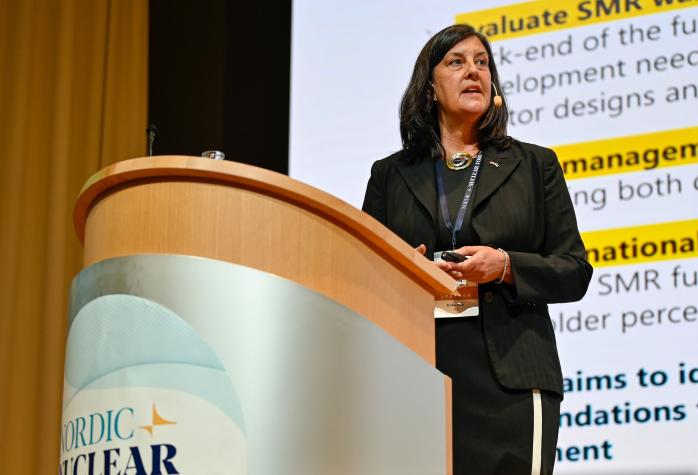
Erika now works in leadership and coordination roles on large European projects dealing with radioactive waste management. She recently coordinated a €24 million project involving 47 institutes around Europe, focused on ways to better treat, condition, and decontaminate waste along with digitalization solutions to more accurately track long-term performance. She is also part of the coordination team for a current €80 million European project on all aspects of radioactive waste management with 150 partners, including in-kind contribution from experts from five USA national scientific labs.
“Even though my background is technical, in this project I also oversee the cross-cutting theme that is knowledge management,” she says. “That means: how do we preserve knowledge? How do we capture knowledge to make sure future generations, or the next generation, will understand the decisions we made?”
Erika’s work also increasingly involves international dialogue, most recently leading the Finnish delegation at this year’s Waste Management Symposium in Phoenix, the largest conference in her field, where Finland was the featured country. She has also worked with the International Atomic Energy Agency (IAEA) in Vienna, supporting countries that are newer to nuclear energy or that need to manage radioactive material from medical or industrial uses.
She is also regularly invited to panels, conferences, and meetings for instance arranged with the U.S. Department of Energy, national laboratories, and universities to explain Finland’s approach and help maintain momentum around solving this challenge.
“How do you handle these materials safely? How do you communicate it to the public? How do you store it?” she says. “A lot of the public fear is that if you have these new nuclear reactors, they’re going to generate waste, and where do we put it? Finland has proven that there’s a solution.”
Erika’s Fulbright connection did not end with her own grant year. After becoming a team leader at VTT, she helped establish the Fulbright-VTT Award in Science, Technology and Innovation, in partnership with the Fulbright Finland Foundation, beginning as a trial in the building technology division before expanding across all disciplines at VTT.
Today, VTT and Fulbright Finland can award up to five professional grants per year, for periods of up to six months. Around twenty grantees have been hosted over the past two decades, and Erika’s own team has hosted several, including researchers in material-science and nuclear-related fields.
“To us, that’s been a great benefit, to strengthen collaboration with people who are doing world-class work in the U.S. also on issues related to groundwater flow, concrete materials, and nuclear simulations,” she says. “We’ve fostered excellent USA-VTT collaboration, and that is something I’m proud of in my Fulbright story.”
She is now in her fifth year on the Fulbright Finland Foundation Board and has also reviewed grant applications for many years. The applicant pool, she says, is exceptionally strong.
“It’s really frustrating to see so many outstanding qualified applicants who aren’t able to come due to funding limitations,” she says. “We know that a lot of times when the U.S. grantees come to Finland, they really love the work style, and they see the impact of their work.”
In times of political, economic, or social turbulence, she believes those personal connections matter even more - with each grantee becoming part of a wider network of influence.
“The Foundation’s work is to bridge those cultural uncertainties and create this foundation of dialogue, trust, and respect,” Erika says. “When we enable Finnish people at any level to go to the U.S., or U.S. people to come here, we’re trying to instill in them the values of cultural respect and learning. We hope that each of them reaches another 100 plus people who have greater interest for Finland-USA relations, and we see that from the alumni and the reach they have. We touch the work of so many branches of Finnish society to enable better communication, greater exchange, and also help to train the future generation and leaders.”
Erika reflects that knowledge of and interest in Finland has grown significantly over the past thirty years in the U.S. What was once an unfamiliar Nordic country is now punching above its weight in terms of reputation and influence.
“It is amazingly different now in my professional and personal circles in the U.S. People really know about Finland. They really want to come to Finland. Programs like Fulbright help build awareness of the impressive society and culture we have here. Fulbrighters are ambassadors to show that there are good messages and impactful things being done.”
Read the whole Fulbright Finland News magazine 1/2026!