Blog

I am writing this from my last week at Northeastern University in Boston (Burlington campus), where I have spent the past month as a Fulbright Finland grantee. I wanted to share what this experience has been like, not the polished version, but the honest one.
This was not my first long visit to the Quantum Materials and Sensing Institute (QMSI), hosted by Professor Kar and the EQUAL Lab. I came here with a plan: three research directions to explore, discuss further, and learn more about. Some of it went exactly as expected. Some of it did not. And some of the most interesting things that happened were never on the list to begin with.
The discussions on 2D quantum materials and organic heterostructures progressed well, leading to a new and exciting perspective on how organic materials interact with and control circularly polarized emission. This research has significant potential for environmental sensing and display technologies.
What surprised me more was how much the AI and machine learning direction expanded during the visit. What started as a conversation about materials discovery grew into something broader: how machine learning tools can actively support everyday research tasks, from data analysis and literature navigation to experimental planning. I am bringing these ideas back to Aalto University to explore firsthand, with the hope of making my work as a researcher both smoother and more effective.
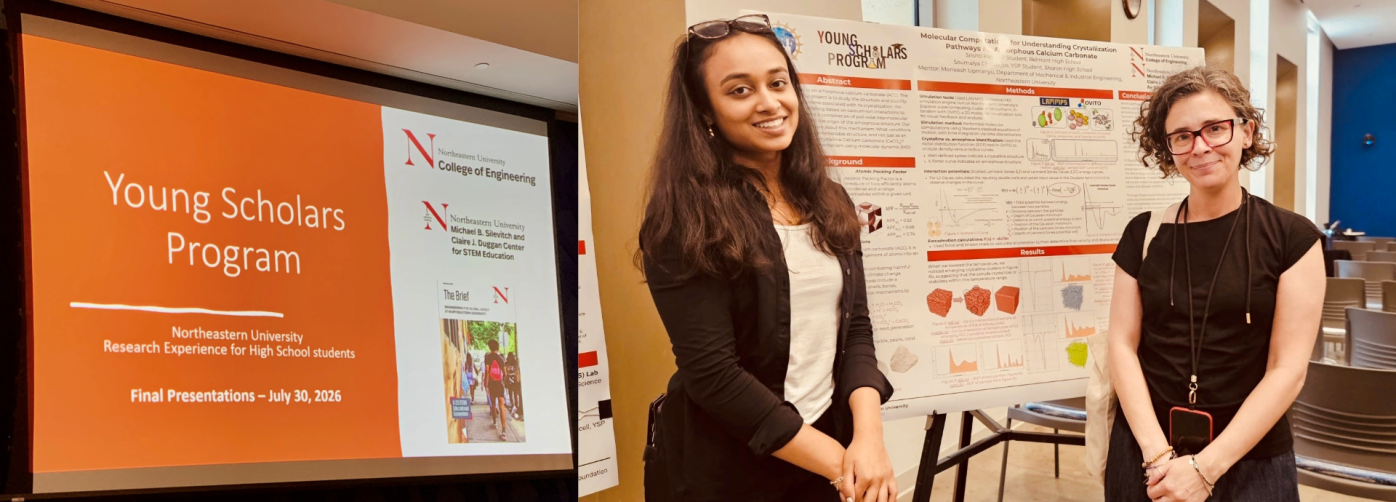
Being physically present also meant saying yes to opportunities that simply would not have been possible from across the Atlantic. One of the highlights was attending the final presentations of Northeastern University's Young Scholar Program, a free summer initiative that brings local high-school students into real research environments for six weeks. Watching them present their work with genuine confidence and curiosity was inspiring.
Programs like this help make STEM fields accessible long before university and reach students who might never have considered a research career otherwise. It was a good reminder of why the broader mission matters, beyond our own labs and research results.
That is perhaps the most underrated benefit of a research visit like this: not necessarily the big breakthroughs, but the steady, focused progress that physical proximity enables.
One ongoing manuscript also advanced during the visit, where daily discussions helped move the work forward. That is perhaps the most underrated benefit of a research visit like this: not necessarily the big breakthroughs, but the steady, focused progress that physical proximity enables. Ideas surface differently around a whiteboard. Conversations go further. You leave a meeting with three new questions instead of one answered email. The Fulbright Finland Travel Grant provided the opportunity to dedicate time to exactly this kind of collaboration.
There is also everything else, the part that does not fit neatly into a research report but matters just as much. A different academic culture, unexpected conversations, and unusual connections between fields all contribute to new ways of thinking.
Scientists are motivated by people as much as by problems, and new environments have a way of creating perspectives that do not emerge when you are focused only on your own routine.
Scientists are motivated by people as much as by problems, and new environments have a way of pushing new perspectives that don't emerge when you are heads-down in your own routine.
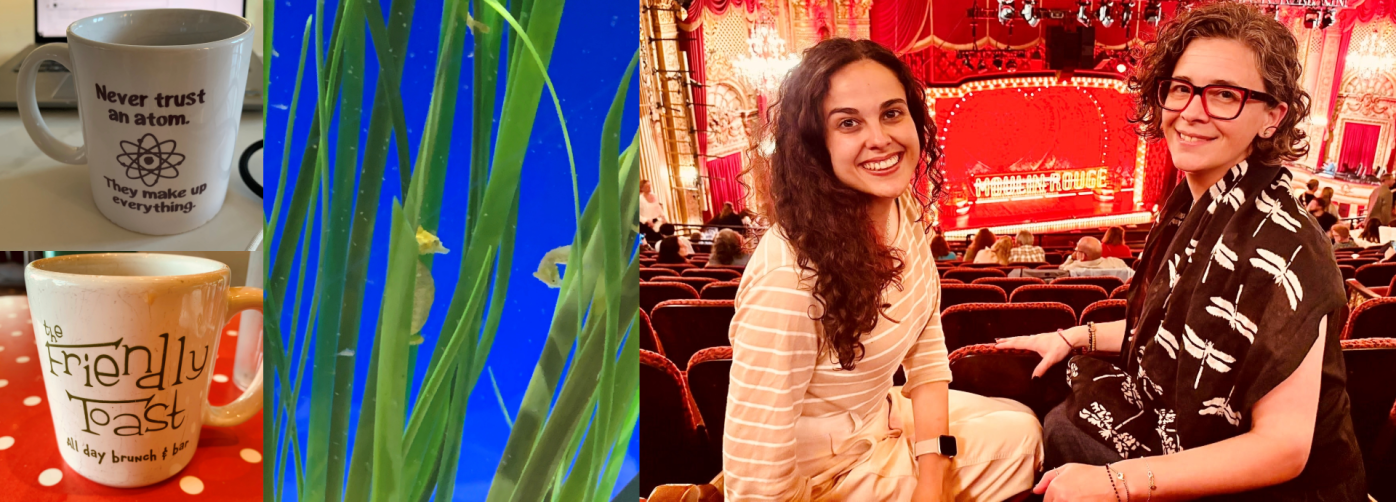
And then there is Boston: my favourite restaurants and cafés, and the New England Aquarium, my happy place. I also had the chance to spend an evening at Moulin Rouge! The Musical with another Fulbright Finland grantee currently at Harvard (hello Ada!). It was a reminder that a research visit is also a human experience, and that the network you build is not only scientific.
Perhaps the most unexpected moment of the whole visit came when I met a Fulbright Finland alumnus (hi Hameed!). Over coffee and banana bread, we shared perspectives on both the United States and Finland. At one point, I showed him a photograph of his current workplace that I had taken during my graduate studies in the United States more than twenty years ago.
It was one of those small but memorable moments that remind you how connected this world really is, and how the threads of a career, yours, mine, theirs, are more intertwined than they appear from inside any single institution.
Whether you are building a new collaboration or strengthening an existing one, the experience can be a turning point for your research and your personal growth. The Fulbright Finland grant gives you the time and legitimacy to go deeper.
I am returning to Aalto University with a manuscript closer to submission, a clearer computational roadmap, a few new AI tools to experiment with, and a collaboration that has grown in both depth and breadth. More importantly, I am returning with a stronger sense of where things are heading and with a network that feels genuinely alive.
If you are considering applying for a Fulbright Finland Travel Grant, do it. Whether you are building a new collaboration or strengthening an existing one, the experience can be a turning point for your research and your personal growth. The Fulbright Finland grant gives you the time and legitimacy to go deeper. And occasionally, a Broadway show.