Fulbright Finland News Magazine

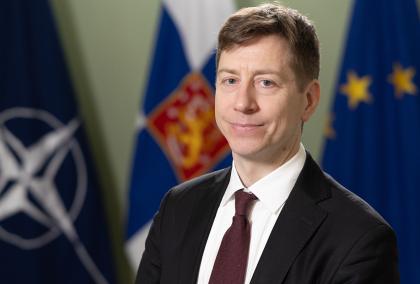
“The Fulbright experience was… I might even say transformative,” says Finnish Ministry of Foreign Affairs senior researcher and Russia specialist, Veera Laine. “I still think about that period of time at least on a weekly basis.”
Today Veera works in the Ministry for Foreign Affairs’ Strategy Unit, helping to support Finland’s foreign and security policy with research-based analysis. Like many Fulbright Finland Foundation alumni who now serve in Finnish diplomacy and foreign policy roles worldwide, she brings both deep subject expertise and an international mindset shaped by study and research abroad.
But long before she joined the Ministry, her interest in Russia – its politics, its history, and the narratives shaping its identity – set her on a path that would eventually lead her from Helsinki to New York City as an ASLA–Fulbright Pre-Doctoral Research Fellow.
Veera’s academic journey began at the University of Helsinki, where she combined Russian translation and area studies with political history. Her early research work at the Finnish Institute of International Affairs (FIIA) solidified her interest in Russia’s internal political dynamics, she explains – and, encouraged by colleagues, she began doctoral research that would eventually take her across the Atlantic.
In 2018–19, Veera was awarded the ASLA-Fulbright Pre-Doctoral Research Fellow Grant. Her project, titled at the time “The Power of Definition – Conceptual History of Nationalism in the Russian Political Discourse,” examined how political actors in Russia explain and understand “Russianness”, and how those definitions shape political practice.
“I think one of the inspirations was that I wanted to broaden my perspective, to know what kinds of perspectives the U.S. community and scholars there would have on the topic that I was working on,” Veera explains. “And of course, the possibility to work for a while in the U.S., that was something I really wanted to try. It was a tremendous opportunity.”
Columbia University’s Harriman Institute, one of the leading centers for Russian and Eurasian studies in the United States, was a natural academic home. But for Veera, the value of the Fulbright experience extended far beyond scholarly exchange.
Living in Harlem with a local host family, participating in seminars at Columbia, and engaging in Fulbright-organized enrichment activities exposed her to a spectrum of social and cultural experiences. She recalls, for example, giving a talk on gender equality in Finland at a Catholic girls’ school in Manhattan, an opportunity that came through Fulbright’s programming. Another highlight was an enrichment seminar in Kentucky on the opioid crisis, which brought together Fulbright grantees from around the world to examine a major social and political issue from multiple perspectives.
“These issues were not related to my research, but it was really inspiring to take part in those discussions about topics that are so important for U.S. politics and also for broader society,” she reflects.
“I think some of the most important lessons from my stay I actually got from my landlady. And from meeting all sorts of different people. It was very meaningful for me personally to get to know such a diversity of people and at the same time recognise that this was only a glimpse of the diversity of the city, and of the country, to also learn about the inequalities within U.S. society, and to hear the personal histories of people I met. I learned a lot.”
The Fulbright connection also revealed an unexpected family link: just before her departure, Veera discovered that her grandfather had also received an ASLA–Fulbright grant in the 1960s as part of a Finnish Social Democratic Party delegation. “It seems that it was rather commonplace at the time for different kinds of professionals to receive this Fulbright grant. It was only after searching through family archives that we found the newspaper photo,” she recalls. “I hadn’t known about that at all.”
After returning to Finland, Veera continued her research at FIIA and completed her doctoral dissertation. In 2022, she joined the Ministry for Foreign Affairs’ Strategy Unit.
Veera explains that the unit’s mandate is wide, providing analytical support, conducting foresight work, and aiming to provide a comprehensive view of global developments. “Our unit is not devoted to any specific geographical area - we aim to cover 360 degrees, so it’s a really broad scope.” For Veera, the role draws on her academic training while requiring adaptation to the time-sensitive and policy-oriented environment of government.
“With my background, I am not a diplomat,” she notes. “I work as a researcher inside the ministry, and in that sense I operate in a kind of liminal space, between state administration and academia.” This allows her to draw on her background in historical analysis - as well as specialist knowledge of Russian history and culture - to inform policy discussions, she explains, stressing that a historical perspective is particularly important at a time when global events can seem so unpredictable, not to mention unprecedented.
“I think historians can often remind us that what we see now may not be entirely new or unique - and so what lessons can be drawn from history?” she explains. “Having a background in history studies, I don’t necessarily have knowledge on every aspect of history, but it’s more like an attitude. There have been unprecedented times before, and every period of time feels unique for those living in and through it.”
Experience of other countries and cultures through exchanges such as Fulbright also plays a crucial role, Veera argues.
“What happens when you change a perspective? It develops a sense of proportion. I think that history does the same – when you learn about past experiences, it puts the present into context. In a similar way, if you live abroad and talk with people who have a very different background than you, that helps to broaden your perspective. You realize that your own perspective is not the only one – it might even be rather marginal.”
What happens when you change a perspective? It develops a sense of proportion. I think that history does the same – when you learn about past experiences, it puts the present into context.
Veera describes the experience of international exchange as “a great luxury and a privilege,” but also argues that such programs play a crucial role in supporting academic freedom, in an age where this seems increasingly under threat.
“I think we should be discussing this a lot more. How do we protect academic freedom and independent thinking? Of course, exchange programs inevitably have a political, ‘soft power’ side as well, creating international connections, in this case, Finnish-U.S. connections. But in the end, they are so valuable because they do enable critical thinking, they enable the scholars to build their own future connections.”
“It’s one of the great aspects of the Fulbright program that you don’t only grow familiar with the U.S. host institution, but also with the other Fulbright scholars coming from all over the world.”
Read the whole Fulbright Finland News magazine 2/2025!